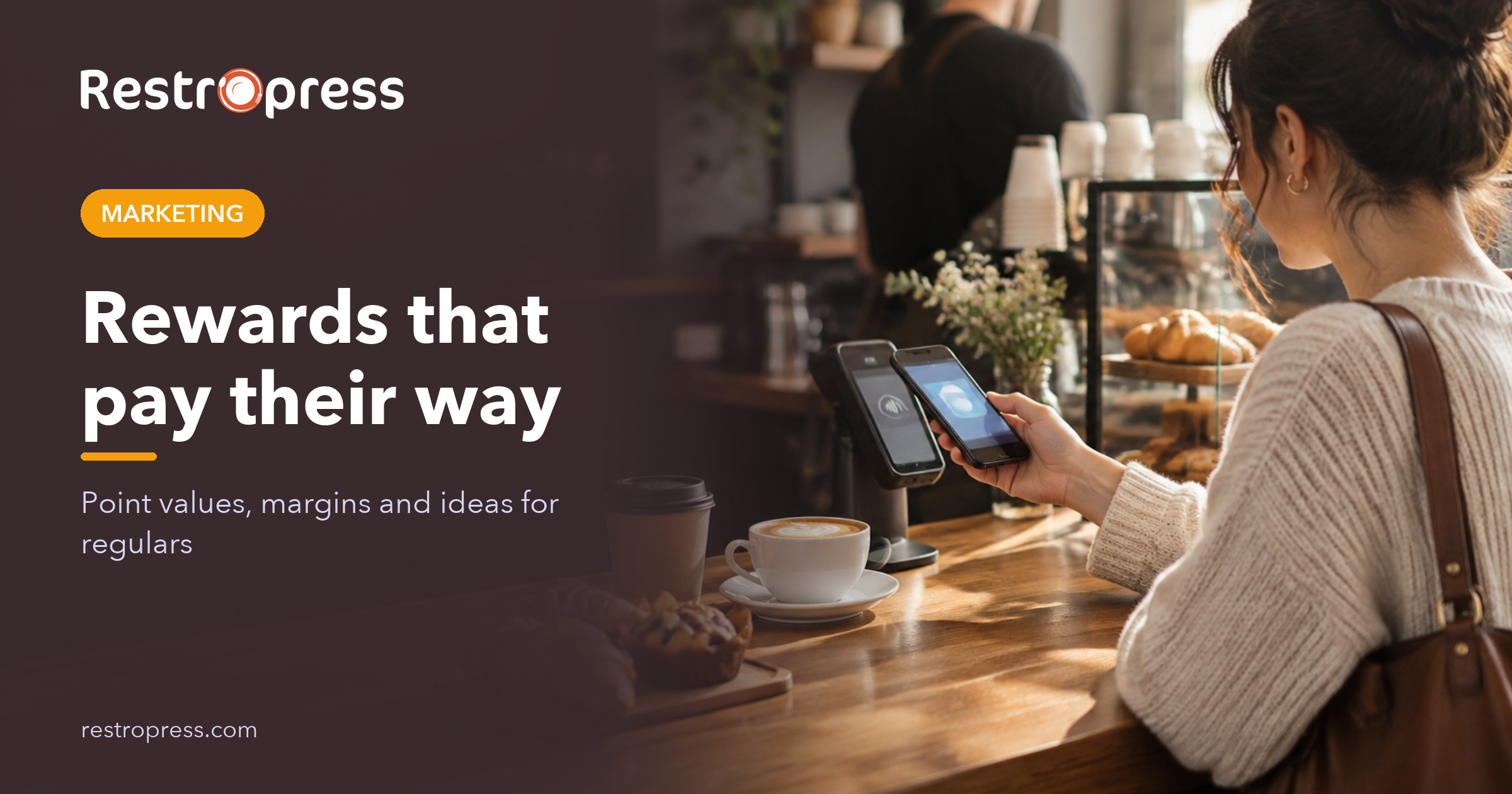
A restaurant loyalty program rewards customers for coming back, usually with points per dollar, a stamp per visit, or perks for higher tiers. The program works when the reward is worth chasing but costs you less than the extra orders it brings, which for most independent restaurants means giving back about 3% to 7% of spend. This guide compares the program types, shows how to set point values with real arithmetic, tests whether a program pays for itself, and gives you launch templates and rules that protect your margin.
Types of restaurant loyalty program
Pick the simplest type that matches how often your customers already visit.
| Type | How it works | Best for | Watch out for |
|---|---|---|---|
| Points per dollar | Customers earn points on spend and redeem them for a discount or item | Most restaurants, especially with online ordering | Point values that are hard to understand |
| Visits or punch card | Buy 9, get the 10th free | Coffee, lunch spots, single-item visits | Rewards a $4 visit the same as a $40 one |
| Tiers | Spend more in a year, earn better perks | Groups with a large regular base | Complex to run, little value for a small restaurant |
| Cashback or store credit | A percentage of spend returned as credit | Simple messaging: “5% back” | Feels like a discount, not a treat |
| Paid membership | A monthly fee for perks such as free delivery | Very frequent customers | Needs volume to be worth signing up for |
| Surprise perks | Unannounced treats for regulars | Fine dining, neighborhood spots | Hard to scale and measure |
For most independents, points per dollar on your own ordering channel plus a birthday treat is enough. Add tiers only once you have hundreds of active members.
How to set point values without losing margin
Every points program reduces to one number: the share of spend you give back. Work it out like this.
Reward rate = points earned per $1 x value of one point in dollars
Example: customers earn 10 points per $1, and 200 points are worth $1 off. One point is worth $1 / 200 = $0.005. The reward rate is 10 x $0.005 = $0.05, or 5% back.
Now adjust for two things.
- Breakage. Some points are never redeemed, because they expire or customers stop coming. If 30% of points expire, the real cost is 5% x 70% = 3.5% of member spend.
- How the reward is paid. A $10 discount off the bill costs you $10 of revenue. A free item worth $10 on the menu costs you only its food cost, say $3 at 30% food cost. Free items are cheaper to give but harder to run online, where a discount at checkout is simpler.
Keep the headline easy to say out loud. “Every $100 you spend earns $5 off” is clearer than “10 points per dollar, 200 points per dollar off”, even if they are the same thing.
| Earn per $1 | Points per $1 off | Reward rate | With 30% breakage |
|---|---|---|---|
| 1 point | 100 | 1% | 0.7% |
| 5 points | 100 | 5% | 3.5% |
| 10 points | 200 | 5% | 3.5% |
| 10 points | 100 | 10% | 7% |
A rate between 3% and 7% after breakage is a sensible range for most restaurants. Go lower if your margins are thin or you deliver with your own drivers; go higher only for a short launch period.
Does a restaurant loyalty program pay for itself? A worked example
Assume a restaurant with 400 members on its online ordering, an average order of $28, and members ordering 1.5 times a month before the program. Assume 60% of each extra dollar of sales is left after food, packaging and card fees, and the program costs 3.5% of member spend after breakage.
- Member sales before: 400 x 1.5 x $28 = $16,800 a month.
- If members order 1.8 times a month after launch: 400 x 1.8 x $28 = $20,160 a month.
- Extra sales: $3,360. Extra margin at 60%: $2,016.
- Reward cost: $20,160 x 3.5% = $705.60.
- Net gain: $2,016 minus $705.60 = about $1,310 a month, before software cost.
Now the cautious view. What lift do you need just to break even? You need extra margin to cover the rewards on all member sales:
0.60 x X = 0.035 x ($16,800 + X), so 0.565 X = $588, and X = about $1,041 of extra sales a month.
At $28 an order that is about 37 extra orders a month across 400 members, or roughly one extra order per member every 11 months. If your program cannot do that, it is a discount, not a loyalty tool. The lesson: a points program is cheap to break even on, as long as the reward rate stays in the 3% to 7% range and you keep promoting it.
Restaurant loyalty program ideas that protect your margin
- Welcome points on account creation, small enough not to be abused (worth $1 to $2).
- Birthday treat as a free dessert or side, which costs food cost, not menu price.
- Double points on slow days, such as Monday and Tuesday, to fill the quiet part of the week.
- Points only on direct orders, so the program pulls customers away from commission-based apps.
- Collection bonus: extra points or a small discount for pickup, which saves a delivery run.
- Minimum redemption so people redeem meaningful amounts, not 30 cents at a time.
- Exclusions for low-margin items such as alcohol, gift cards or delivery fees.
- Expiry after inactivity, which rewards regulars and gives lapsed customers a reason to return before points vanish.
- New dish preview for top members: a free taste of a new item before launch, and honest feedback.
- Referral reward when a friend places a first order, paid to both.
- Lapsed-customer nudge: an email or text when points are about to expire.
One thing not to do: give points for Google reviews. Google’s rating manipulation policy forbids offering discounts or free items in exchange for reviews.
Rules that keep the program profitable
Write these down before launch, and put the short version on your website.
- Earn rate and value. Points per $1 and what points are worth.
- What earns. Paid food orders, before tips and delivery fees.
- What does not earn or redeem. Restricted items and categories.
- Minimum and maximum redemption per order.
- Expiry. For example, points expire 60 days after your latest order.
- Cancellations and refunds. Points earned on a cancelled order are removed.
- Changes. You may change the program with notice.
Outstanding points are a promise to customers. Ask your accountant how to treat them in your books, especially if the balance grows large.
Launch checklist and announcement templates
- Decide the type, reward rate and rules.
- Set it up and place test orders: earn, redeem, cancel.
- Brief staff with a one-line answer: “You get 5% back in points on every online order.”
- Announce through every channel for the first two weeks.
Email subject: “You now earn on every order at [Restaurant]”
Email body: “From today, every online order earns points: $5 off for every $100 you spend. Create your account at [link] to start earning. Points stay valid as long as you order at least once every 60 days.”
SMS (opted-in customers only): “[Restaurant]: new rewards. Order online at [link] and earn $5 back for every $100. Reply STOP to opt out.”
Counter sign or bag insert: “Order online, earn rewards. $5 off for every $100. Scan to join.”
Metrics to track every month
| Metric | How to calculate | What it tells you |
|---|---|---|
| Active members | Members who ordered in the last 60 days | Whether the program is alive |
| Order frequency | Member orders / active members | The main thing you are paying for |
| Average order value | Member sales / member orders | Whether people spend more to earn |
| Redemption rate | Points redeemed / points issued | Too low means the reward feels out of reach |
| Reward cost | Value redeemed / member sales | Should sit inside your 3% to 7% target |
| Outstanding points | Points issued, not redeemed or expired | Your future cost |
For comparison, Square includes loyalty in its paid plans rather than its free plan: its US pricing page lists loyalty rewards and promotions on Plus ($49 a month per location) and Premium, as of November 2026. Whatever tool you use, the numbers above are what decide whether it works.
Run a points program on your own ordering site with RestroPress Rewards
If you take orders on your own WordPress site with RestroPress, the Rewards extension runs a points program inside your checkout, with no card or separate app. Based on its documentation:
- You set how many points customers earn per unit of currency, plus the redemption rate that turns points into money off.
- Logged-in customers earn on paid orders, and the balance is credited when they reach the order receipt page.
- At checkout, the Promo and rewards block shows the balance. The customer enters points to use, clicks Apply, and the discount appears as a Points line.
- You set minimum and maximum points per order.
- Points expire a set number of days after the customer’s latest order, 60 by default, and the date resets each time they earn.
- Restricted items and categories earn no points, and points cannot be redeemed on an order that contains them.
- Points from a cancelled order are deducted automatically.
- Your Customers screen shows each customer’s points and expiry date.
Limits to know: the earn rate is one global setting, so you cannot give one dish more points than another, and guests must log in to earn. Ideas such as double points on slow days or birthday treats would need to run outside the extension, for example through email. To keep members coming back between orders, pair it with Mailchimp Integration for campaigns.
Rewards is included in the Professional, Business and Agency plans, or costs $49 a year on its own for one site. See the pricing page for plans.
Common questions
How many points per dollar should a restaurant give?
The count matters less than the value. Aim for a reward rate of 3% to 7% of spend after breakage. For example, 10 points per $1 with 200 points worth $1 gives 5% back.
Are loyalty programs worth it for small restaurants?
Usually, if they run on a channel you control and you promote them. In the example above, 400 members needed only about 37 extra orders a month to cover the cost of rewards.
Points or punch card: which is better?
Points suit varied order sizes and online ordering. Punch cards suit simple, similar-priced visits such as coffee. Punch cards reward a small order the same as a large one.
Should loyalty points expire?
Yes, with a fair window tied to inactivity. Expiry limits your outstanding cost and gives lapsed customers a reason to order again before they lose their balance.
Next step
Turn your direct orders into repeat orders. See how the RestroPress Rewards extension sets earn rates, expiry and limits at checkout.