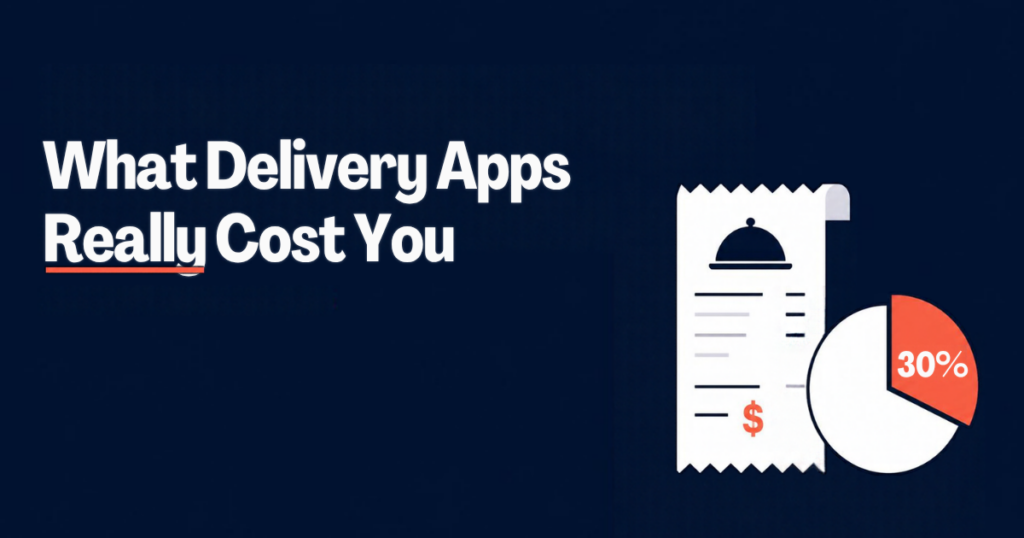
“How much does DoorDash charge restaurants?” is one of the most searched questions in the trade, and the honest answer is: more than the headline percentage. Commission is only the first line. Add pickup fees, payment processing, promotions, menu inflation and the customer you never meet, and the real cost of a delivery-app order is often a third of the ticket or more. This article does the maths with published figures, then shows how to move your repeat customers to ordering directly from your own website.
What the delivery apps actually charge
Start with what the platforms themselves publish. Uber Eats lists its US marketplace fees openly: 20% for the Lite plan, 25% for Plus and 30% for Premium on delivery orders, plus a 7% pickup fee (10% if your in-store prices are not validated), and 15% if you use your own drivers (Uber Eats pricing page).
DoorDash and Grubhub publish their plan structures but the exact percentages are harder to pin down from their public pages. Grubhub’s merchant site advertises “rates as low as 5%” for marketing commission (Grubhub for Restaurants), which is the floor, not the typical total. A 2026 industry round-up by POS vendor Rezku summarises DoorDash delivery commission at 15% to 30% depending on plan, with pickup around 6% and processing around 6% more, and Grubhub at 10% to 25% delivery commission plus roughly 3% + $0.30 processing (Rezku, 8 April 2026). Those are a vendor’s figures rather than the platforms’ own, so treat them as a guide and check your own contract.
In the UK the picture is similar. Which? reported restaurants paying between 15% and 35% of the order total in commission, with one restaurant quoting 30% on orders over £25 and 33% below (Which?, June 2021). Deliveroo told Which? its rates are tailored to each restaurant, which is why you will rarely see a single number.
The delivery app commission maths on a real order
Take a $40 order on a 30% plan, the top tier on Uber Eats and the commonly quoted top tier elsewhere.
| Line | Amount |
|---|---|
| Order subtotal | $40.00 |
| Commission at 30% | -$12.00 |
| Payment processing (illustrative 3% + $0.30) | -$1.50 |
| Paid promotion, if you run one (illustrative $2 off, funded by you) | -$2.00 |
| You receive | $24.50 |
That is 61% of the ticket, before food cost, labour and packaging. A typical restaurant runs food cost at roughly 30% and labour at a similar level; on $24.50 you have $12 of ingredients and $12 of labour to cover from a $40 order. The arithmetic is tight even before rent.
Now the same $40 order through your own website with a flat-fee ordering system:
| Line | Amount |
|---|---|
| Order subtotal | $40.00 |
| Commission | $0.00 |
| Payment processing via your own Stripe/PayPal (illustrative 2.9% + $0.30) | -$1.46 |
| You receive | $38.54 |
The difference is about $14 on one order. At 20 app orders a day, that is roughly $280 a day, or over $100,000 a year, that goes to the platform rather than to you. The exact number depends on your plan and volume, but the direction is not in doubt: the commission is almost always the single largest “expense” on an app order, and it is one you can shrink.
The costs that do not show up on the statement
Menu inflation that drives customers away
Most restaurants raise app prices to claw back commission. Which? found the same Lebanese meal cost £26.42 direct and £38.04 on Deliveroo, a difference of £11.62 (Which?). Customers notice. Some stop ordering; others assume you are the expensive one.
You do not get the customer
The app has the name, phone number, address and order history. You get a first name on a receipt. You cannot email them a Tuesday offer, invite them to a tasting night, or tell them when you move to a new ordering link. Every order is, from your point of view, a first order.
Refunds and disputes
App refund policies generally favour the customer, and the cost of a missing-item claim is usually charged back to the restaurant. On your own site you decide.
Your competitors are one swipe away
On a marketplace you are listed next to every other place that does your cuisine, often with a promotion badge paid for by a chain. On your own site there is only you.
How to move repeat customers to direct ordering
Nobody is suggesting you delete your DoorDash account. Marketplaces are a decent way to be found by people who have never heard of you. The plan is to let the apps bring the first order, and make sure the second comes to you. Here is what works.
1. Have a direct ordering site worth sending people to
It has to be as easy as the app: a mobile-friendly menu, saved addresses, one-tap reorder, Apple Pay or Google Pay through Stripe, and clear pickup and delivery times. The free RestroPress plugin gives you this on your own WordPress site with no commission; paid extensions add delivery zones and fees and store timings and cut-offs so your site makes the same promises the app does. See pricing for what each plan includes.
2. Put the direct price lower than the app price
You are already charging more on the apps to cover commission. Keep that gap and tell people about it: “Order direct at ourrestaurant.com and pay menu prices.” A pickup discount extension can automate a further few percent off for collection orders.
3. Use the bag
Every app order leaves your kitchen in a bag you control. A printed card with a QR code to your ordering page and a first-order code (free delivery, a free side) is the cheapest marketing you will ever do. The person opening that bag has just proved they order from you.
4. Fix your Google Business Profile
Google lets delivery apps attach themselves as “Order online” buttons on your profile. Set your own site as the primary ordering link, and remove or demote third-party links you did not ask for. Most of your branded searches come through that profile.
5. Reward the second order
A simple points scheme, where points are earned on direct orders only, gives regulars a reason to switch channels. RestroPress has a Rewards extension for this on the Professional plan and above; a manual stamp card works too.
6. Measure it
Track direct orders as a share of total online orders each month. If it is climbing, the plan is working. Restaurants that do this consistently usually find the share flips within a year, at which point the app becomes what it should always have been: an advertising cost, not a tax on every meal.
Frequently asked questions
Does DoorDash charge restaurants for pickup orders?
Yes. Pickup orders carry a lower commission than delivery, but they are not free. Uber Eats publishes a 7% to 10% pickup fee; industry round-ups put DoorDash pickup at around 6%. Check your own agreement for the exact rate.
Can I legally charge more on the apps than on my own menu?
In most markets yes, and many restaurants do. Some platforms have terms about price parity, and Uber Eats charges a higher pickup fee if your in-store prices are not validated, so read your agreement. Discounting direct orders rather than marking up app orders avoids most of the complication.
What does a commission-free ordering system cost instead?
RestroPress’s core plugin is free. Paid plans are a flat yearly licence that does not change with order volume, plus your normal card processing. Compare that with a percentage of every order, and the break-even point for a restaurant doing even a handful of app orders a day is usually a few weeks.